
HOW TO IMPORT HAIR FROM VIETNAM? (NO-RISK & FACTORY-DIRECT GUIDE 2026)

May
Every year, hundreds of salon owners and beauty entrepreneurs search for how to buy hair from Vietnam with the dream of sourcing directly from the factory. Yet, industry statistics show that nearly 80% of B2B beginners lose their initial capital on their very first order. The reason isn’t the quality of the hair; it is because they fall into the traps of unlicensed brokers, fake factory accounts, and hidden shipping fees.
If you are planning to import inventory for your brand, you need more than just a WhatsApp contact. This guide provides a step-by-step, risk-free blueprint on how to buy hair directly from Vietnam safely, protecting your payments, verifying hair quality remotely, and navigating customs clearance to keep your profit margins secure.
Decoding the Market: Understanding Vietnamese Hair Types and Standards
Before importing hair from Vietnam, you need to understand how the market actually defines quality. Most online content simplifies everything into “Virgin Hair” or “Remy Hair,” but in real wholesale trade, the system is far more technical.
Origin-Based Classification: Raw Hair vs. Remy Hair

Raw Hair: This is 100% unprocessed human hair cut directly from a single donor’s ponytail. The cuticles remain completely aligned and intact, and the hair has never undergone any chemical, steam, or heat processing. It is the strongest, most durable hair type available, making it the luxury standard for professional coloring, lifting to platinum blonde (#613), and long-term salon wear.
Remy Hair: This hair is collected from multiple donors but sorted carefully so that all cuticles run in the same direction. It is often steam-styled to create uniform wave patterns (like body wave or deep wave) or dyed into popular color shades. It offers a highly reliable, salon-ready option at a more accessible wholesale price point.
The “Virgin Hair” Reality Check: Many suppliers use the label “Virgin Hair” purely for marketing. In bulk wholesale trade today, true single-donor, chemical-free virgin hair is highly rare and expensive. Most commercial “Virgin Hair” sold online is actually high-quality Remy hair that has been gently processed.
In practice, buyers should focus on performance (shedding, tangling, bleaching ability) rather than marketing labels.
Thickness Grading and Bundle Standards

Vietnamese hair vendors grade their bundles based on the ratio of full-length hair strands to shorter strands within a single bundle:
Single Drawn: Contains a high percentage of short hair strands mixed into the bundle. The hair is thick at the top but becomes noticeably thinner at the ends. It is the most affordable option, suitable for layered haircuts.
Double Drawn: Features a balanced thickness from root to tip. A significant percentage of the strands are of equal length, giving the bundle full, clean ends. This is the standard choice for most global hair brands.
Super Double Hair / Luxury Drawn: The highest quality grade available. Nearly all strands in the bundle are of identical length, resulting in maximum fullness, thick ends, and a heavy, premium feel.
Vietnamese Popular Product Categories
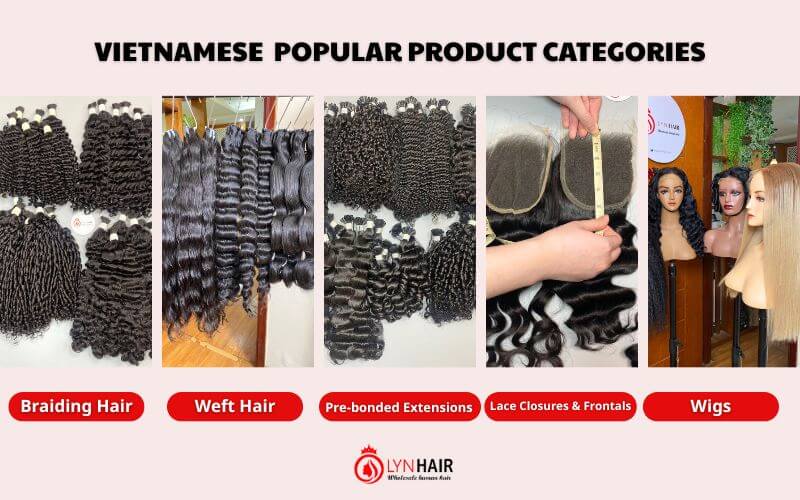
Braiding Hair: Raw, loose hair strands tied in bundles with no wefts. It is the premium choice for high-end braiding, twisting, and custom ventilation by stylists who want to offer long-lasting, natural-looking braided styles.
Weft Hair: Hair strands sewn onto a track (machine-made or hand-tied) used for traditional sew-in installations.
Pre-bonded Extensions: Hair equipped with keratin tips (I-tips, U-tips, Flat-tips) or tape-in systems for quick salon applications.
Lace Closures & Frontals: Hand-knotted lace pieces (usually in sizes like 4×4, 5×5, 13×4, or 13×6) using HD or transparent lace to create a natural-looking hairline.
Wigs: Full-head hair units constructed by sewing wefts onto a wig cap paired with a closure or frontal. In the modern market, ready-to-wear glueless wigs, closure wigs, and pre-customized colored wigs are in massive demand due to their convenience and natural look.
Factory vs. Trading Company vs. Ghost Brokers (Scammers)
When researching suppliers, you will find both direct factories and trading companies. To build a secure supply chain, you must understand how they operate and how to avoid independent scammers.
The Reality of “Factory vs. Trading Company”
Do not judge a supplier solely by whether it is a factory or a trading company. In Vietnam’s hair industry, both business models serve different purposes and can offer distinct advantages.
Trading companies often maintain a broader and more flexible product portfolio by working with multiple manufacturing partners. This allows them to source various hair types, colors, textures, and extension methods, making them a convenient option for buyers seeking diverse product categories from a single supplier.
Factories, on the other hand, tend to focus on specific product segments and markets where they have developed the strongest expertise. Rather than producing every type of hair product available, many manufacturers specialize in particular categories such as raw hair, wigs, textured extensions, blonde collections, or custom-colored products.
As a result, the best supplier is not necessarily the one with the largest factory, but the one whose product strengths align most closely with your business needs and target market.
Read More: VIETNAMESE HAIR FACTORY IN UK
The Real Threat: Ghost Brokers
Your goal is not to avoid trading companies, but to steer clear of “Ghost Brokers”. These are independent, unlicensed middlemen (locally known as “cò mồi”) who own no office, hold no stock, and have no registered business entity. They copy product photos from popular Instagram feeds, quote bait prices, and disappear the moment they receive your deposit. Legitimate wholesale suppliers—whether factories or trading companies—will have physical offices, active registration, and transparent business operations.
The “Anti-Scam” Verification Checklist
Before sending any money to a vendor, run through this verification checklist:

Pricing and Capacity Alignment
Legitimate Vendors: Will provide a structured, official price sheet. They can easily handle large, recurring wholesale orders (100kg+ per month) and remain transparent about production lead times.
Ghost Brokers:Often offer unrealistically cheap prices to bait beginners. Once you pay, they add unexpected “handling fees,” delay shipping for weeks, or send mixed, lower-grade hair because they have no control over the supply chain.
The 3-Step Live Video Call Test (Scammer Proof)
Do not rely on beautiful Instagram grids or pre-recorded videos. Request a live WhatsApp video call with the sales representative and perform these three checks:
The Live Tour: Ask the representative to show you the staff working on the sorting floor, the stock shelves, or the office surroundings in real-time.
The “Handwriting” Test:Pick a random bundle of hair on the screen. Ask the sales representative to write your name and the current date on a piece of paper and place it directly next to that bundle. A scammer using pre-recorded video loops or green screens will immediately make excuses and decline.
Form & Texture Check: Ask them to run a wide-tooth comb through a straight bundle on camera or pull a curly weft to inspect the bounce, density, and elasticity in real-time.
>> Click to chat with verify Vietnamese hair factory <<
Secure Payment Structures & Financial Security
Legitimate Vietnamese hair exporters offer flexible, verified payment options designed to optimize transaction fees and accommodate international banking regulations:
Alternative Currency Solutions: Top-tier suppliers support international buyers by working with authorized logistics and financial partners. This helps buyers from specific regions (such as Nigeria) bypass the challenges of sourcing USD, simplifying local accounting and transaction processing.
Secure Express Payment Channels: For sample orders or small trial purchases, vendors often accept global transfer services like Western Union or Remitly to minimize international banking fees and accelerate production times. Buyers are advised to always verify the supplier’s official business identity, registered corporate communication channels, and Proforma Invoice (PI) details prior to remittance.
The Milestone Deposit Policy: Trustworthy manufacturers operate on a structured 30% to 50% deposit framework to initiate custom production. The remaining balance is only settled after you perform a comprehensive remote quality inspection via a live video call.
Pro Tip: Standard B2B wholesale practices always involve a split payment (Deposit + Balance). Be cautious with any vendor requiring mandatory 100% upfront payment for large-scale bulk orders before production begins.
The Step-by-Step Ordering & Negotiation Process
To get the exact quality and texture you want at the best possible price, follow this sourcing protocol:

Step 1: Send a Photo for Price & Quality Matching
Never order hair based on simple text descriptions or generic color codes. Hair textures and color shades vary between different factories. A common practice for boutique owners is to find a trending color from a high-end brand’s social media and send it to their Vietnamese vendor to replicate.
Step 2: Negotiation Tactics for Beginners
Negotiating Lower MOQs: If a supplier has a high MOQ, explain that you are establishing a new brand and need to test the hair’s reaction to washing and bleaching first. Ask for a “Sample Exemption” of 2–3 bundles before committing to a larger order.
Confirming the Quality Warranty: Ask the sales rep directly on WhatsApp: “What is your return policy if the hair sheds excessively or tangles after the first wash?” Save their written response as your B2B service agreement.
Step 3: Proforma Invoice (PI) & Deposit
Once the details are finalized, your sales representative will issue a Proforma Invoice (PI) detailing the itemized costs, shipping fees, payment agent details, and production time. Review the PI carefully, make your deposit (30% to 50%), and send the receipt to lock in your production slot.
Remote Quality Control (QC) Protocols Before Shipping
Before the vendor ships your package, you must perform a remote quality inspection to ensure the goods match your invoice:

- The Shedding Test: Have the sales representative run a comb firmly through the wefts on camera to verify that the stitching is tight and the hair does not shed.
- The Tangling Test: Have them run their fingers upward from the tips to the roots. If the fingers glide smoothly, the cuticles are aligned. If the hair catches or bunched up, the cuticles are mismatched, which will cause tangling later.
- The Bleaching Test: If you are buying raw hair for coloring, ask the vendor to confirm that the batch can lift cleanly to #613 blonde. Low-quality hair or synthetic mixes will melt, turn orange, or break during this test.
Logistics & Customs: Strategic Shipping Routes
Choosing the wrong shipping channel can lead to customs seizures, high duties, or lost packages. Use the right route for your market:
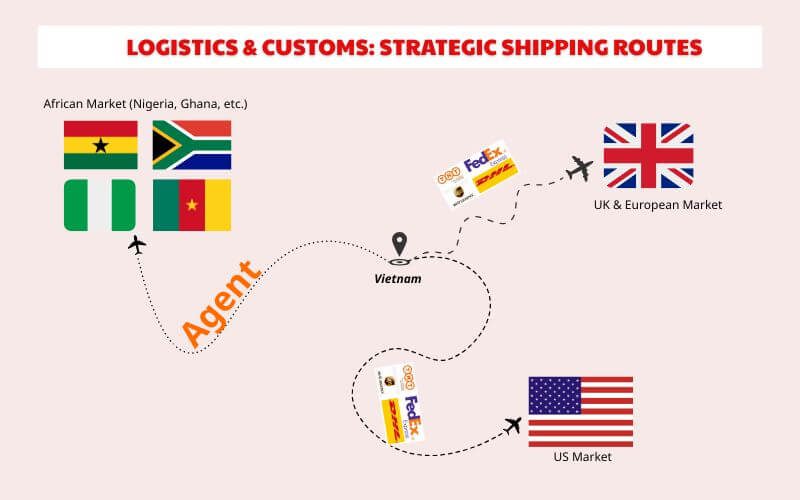
- The UK & European Market
For European and UK markets, DHL Express is the most reliable option due to its established local tracking network and smooth customs clearance procedures.
- The US Market
Both FedEx and DHL work exceptionally well for shipments to the United States. They offer fast, 3-to-5-day delivery and automated customs clearance for standard commercial shipments.
- The African Market (Nigeria, Ghana, etc.)
Shipping hair to African markets requires specialized logistics due to complex customs procedures and high import regulations. To ensure safe delivery and keep shipping costs predictable for your business, almost all shipments are handled through dedicated shipping agents.
How It Works: Your hair packages are aggregated and flown via specialized air cargo. Once the shipment lands, local clearing agents in destination hubs like Nigeria (Lagos) or Ghana (Accra) handle the entire customs clearance process smoothly.
Door-to-Door & Office Pickup: Depending on your arrangement, these agents will either arrange secure final delivery to your doorstep or allow you to easily pick up your cargo directly from their local offices in Lagos or Accra.
>> Need help sourcing hair from Vietnam? Contact our team for a free consultation and expert guidance on importing Vietnamese hair worldwide.<<
Top Verified Hair Suppliers in Vietnam
Choosing a supplier is about finding the right fit for your business model. Here are the top three verified B2B hair suppliers in Vietnam for 2026:
Lyn Hair – Best for Sourcing Vietnamese quality raw hair

Lyn Hair serves hair brands, wholesalers, salon suppliers, and online retailers with a broad range of human hair products, including wigs, bundles and closures, frontals, and extensions. The company is known for its flexible manufacturing capabilities, supporting custom lengths, textures, colors, densities, and product specifications tailored to different market demands.
With experience serving international buyers across multiple regions, Lyn Hair helps brands develop product collections that align with their target customers while maintaining consistent production standards and wholesale pricing.
In addition to its customized Remy Virgin Hair collections, the company also offers premium Raw Vietnamese Hair for buyers seeking higher-end product lines. Its raw hair is carefully selected and categorized by natural strand characteristics, providing more options for brands targeting different customer preferences.
Apo Hair – Best for European Salon Extensions

Apo Hair is an established factory primarily serving high-volume, mass-market distributors in Western countries.
Pros: Large stock capacity and predictable shipping times for standard ready-to-wear extensions (clip-ins, tape-ins) tailored for fine European hair.
Cons (Considerations): Their mass-production model comes with high premium pricing and fixed annual price hikes that cut into startup profit margins. Furthermore, while they do supply raw bulk hair, their core manufacturing line is heavily optimized for mass-processed extensions—making them less flexible than specialized factories when handling small-batch, highly customized raw hair orders for boutique brands.
Cy Hair – Best for Small-Scale Customized Wigs

Cy Hair is a Southern Vietnam-based supplier focusing on finished, styled extensions and ready-to-wear wigs.
Styling Flexibility: Suitable for wig makers needing customized waves, curls, and pre-colored lace closures.
Small-Batch Support: Flexible and highly responsive to small, custom fashion orders.
Considerations: Less competitive for bulk raw bulk hair sourcing due to their location away from Northern Vietnam’s main raw material hubs.
Read More: TOP 5 BEST VIETNAMESE HAIR VENDORS
Frequently Asked Questions (FAQs)
What is the average wholesale MOQ for Vietnamese hair?
Most large Vietnamese suppliers require a minimum order of 10 bundles (1kg) or 5 bundles. However, startup-friendly vendors like Lyn Hair offer a no-MOQ policy for sample orders, allowing you to buy a single bundle to test the quality before placing a bulk order.
What secure payment methods do Vietnamese vendors accept?
Reputable Vietnamese suppliers support flexible, verified payment options including international bank transfers (T/T), Western Union, and Remitly. To support international buyers operating in regions with tight foreign exchange liquidity, top-tier Vietnamese suppliers partner with accredited global financial networks and licensed logistics clearers. This enables smooth cross-border trade by offering compliant multi-currency payment solutions, allowing African corporate buyers to settle manufacturing and shipping invoices through verified local financial gateways efficiently.
What should I do if the received hair quality doesn’t match the sample?
Always review the vendor’s warranty policy before sending your deposit. If you receive a batch that does not match your approved video quality check, contact your representative immediately with video proof of the defect to arrange a replacement or credit.
Conclusion: HOW TO IMPORT HAIR FROM VIETNAM?
Importing hair directly from Vietnam is a highly effective way to build a profitable hair brand. By avoiding ghost brokers, using the live video call test to verify your goods, and choosing a versatile partner like Lyn Hair that can supply both custom Remy colors and premium raw hair, you can confidently scale your brand in the global Black women hair market.
